
AI governance tool for safe and democratic transitions
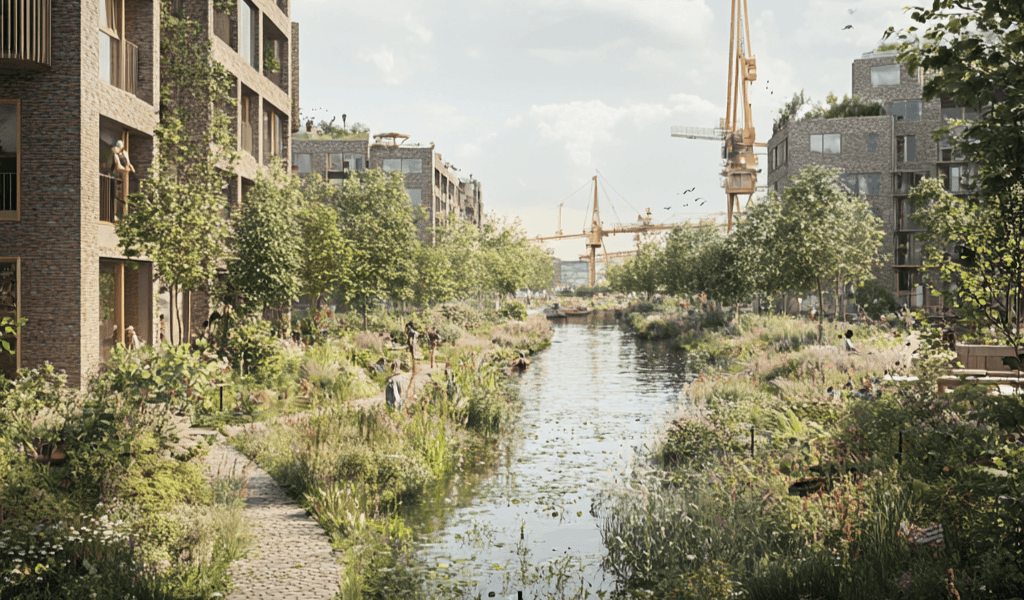
Denmark’s green transition requires major spatial and land‑use changes - from renewable energy infrastructure to biodiversity restoration, agricultural restructuring, and urban densification. These transformations reshape landscapes and everyday life, and they often generate mistrust when planning processes appear opaque, technocratic, or socially uneven. At the same time, generative AI is rapidly entering planning practice as a tool for visualising future landscapes. These visualisations influence how people imagine possible futures, yet globally trained AI models often reproduce generic sustainability aesthetics that overlook local ecologies, lived experience, and social values.
This fellowship addresses a central governance challenge: How can generative AI be used in spatial planning in ways that are democratically accountable, locally grounded, and institutionally robust?
Research Focus
The project builds on the GSC Living Lab Urban Solutions to the Green Transition, which has developed a unique spatial evidence base: a representative PPGIS dataset of meaningful and contested nature sites, a geo‑coded digital photovoice dataset linking perceived biodiversity and social qualities, and an interactive Atlas integrating quantitative and qualitative spatial data. The Living Lab has also piloted a participatory GenAI method where residents and professionals co‑vision future landscapes using locally grounded prompts.
The fellowship will transform this promising pilot into a formalised governance tool that integrates spatial data, participatory engagement, AI transparency, and democratic validation. It directly addresses two GSC knowledge gaps: Lack of cross‑sectoral coordination and citizen involvement (Gap 3), and insufficient knowledge of the development and testing of new modes of integration and implementation (Gap 10).
Objectives
The fellowship aims to:
- develop a KU‑based interdisciplinary governance tool for participatory, accountable use of GenAI in land‑use planning
- refine methods for data‑grounded prompting, bias detection, traceability, and democratic validation
- test the tool with municipalities, industry partners, and local communities
- build an interdisciplinary research environment on participatory AI governance across SCIENCE, SAMF, HUM, and LAW
Planned Activities
The fellowship will proceed through a structured development pathway:
- Consolidation of the Living Lab pilot, including systematising workflows and identifying methodological gaps
- Interdisciplinary co‑development workshops with researchers in AI safety, social data science, anthropology, humanities, communication, and law to refine the governance framework
- External qualification through workshops with municipalities and industry to test scenario packs, transparency mechanisms, and accountability protocols
- A mini‑pilot implementation in collaboration with the TRANSFORM project, applying the full model in a peri‑urban or rural district and evaluating its transferability beyond the urban context
By the end of the fellowship, the project will deliver a refined governance framework, a documented pilot case, a policy brief, and a draft co‑authored academic publication.
Long‑Term Vision
The fellowship will establish a KU‑anchored platform for participatory AI and land‑use governance, expanding the GSC Living Lab Urban Solutions to the Green Transition into a transferable method for agricultural, peri‑urban, and transitional landscapes. It will contribute to the development of a public‑sector service format that integrates spatial evidence, participatory co‑visioning, AI transparency, and place‑based validation.
In the longer term, the project will position UCPH as a national leader in accountable AI governance for green transitions. It strengthens institutional capacity to integrate computational, social, and humanistic expertise in addressing complex environmental governance challenges and lays the groundwork for competitive applications to national and EU funding programmes.